How to Select PTFE Coated Fiberglass Fabric for Industrial Applications
The right PTFE coated fiberglass fabric is selected by matching the substrate, coating level, thickness, surface finish and product grade to the real process. Thin, smooth fabric is often preferred for heat sealing and release sheets, while heavier constructions provide more body and strength for demanding industrial service. Food-contact and antistatic applications require an exact grade with supporting documentation; color alone is not enough.
This PTFE coated fiberglass fabric selection guide explains how to compare available specifications and how to provide the information a manufacturer needs before recommending a material.
Quick PTFE Fabric Selection Table
The table below is a starting point for sample selection. Final suitability should be verified under the actual temperature, pressure, chemical exposure and mechanical loading of the application.
| Main requirement | Practical starting point | What must be confirmed |
| Heat sealing and packaging | Thin to medium closed-weave fabric with a smooth release surface | Sealing temperature, dwell time, pressure, surface marking and required flexibility |
| Release sheet or separator | Smooth, well-coated closed fabric | Surface texture, release life, product finish and cleaning method |
| Laminating and photovoltaic processing | Dimensionally stable fabric with consistent thickness and a flat surface | Lamination temperature, vacuum cycle, panel finish, width and replacement interval |
| Conveyor or transfer surface | Fabric thickness and strength matched to the load, roller diameter and joint | Belt width, endless length, speed, tension, tracking, joint and pulley diameter |
| Food-processing contact surface | An appropriate production grade supported by documents for the exact supplied material | Food type, contact time, temperature, repeated-use conditions and destination-market requirements |
| Static-sensitive process | A specified antistatic grade | Required resistance range, test method, grounding arrangement and operating environment |
| Gasket, diaphragm or flexible barrier | Medium to heavy fabric selected for body and strength | Pressure, flexing, chemical media, sealing surface and fabrication method |
| Adhesive-backed tape or liner | Thin, flexible fabric compatible with the selected adhesive | Adhesive type, operating temperature, release liner, bond surface and removal requirement |
Understand the Material Before Comparing Product Codes
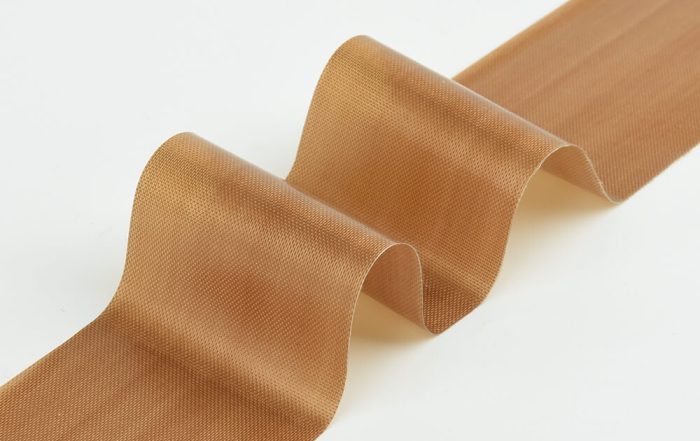
PTFE coated fiberglass fabric combines a woven glass-fiber substrate with a cured polytetrafluoroethylene coating. The two components do different jobs:
- The fiberglass fabric provides much of the tensile strength, dimensional stability and structural body.
- The PTFE coating creates the release surface and contributes non-stick performance, low friction and resistance to many chemicals.
The finished material is therefore not defined by PTFE content alone. Two fabrics of the same thickness can behave differently if they use different base cloths, yarn counts, weaves, coating levels or curing processes. A smooth, highly coated grade may give better release and a less textured finish, while a fabric with more visible weave may remain more flexible or economical for a process that does not require a premium surface.
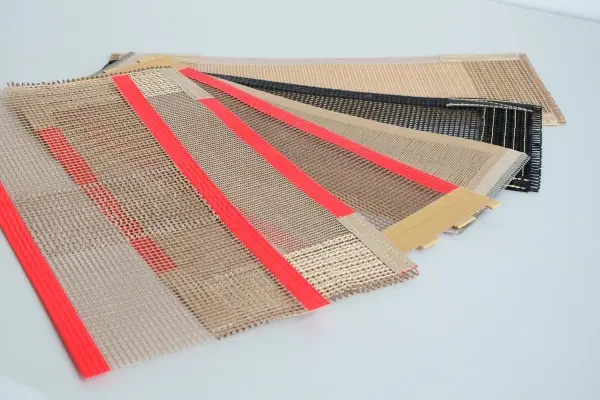
Jiujiang PTFE’s current PTFE coated cloth product range includes closed woven fabric and open-mesh fabric, normal thicknesses from 0.08 to 1.00 mm, coating percentages from approximately 15% to more than 60% by weight, widths from 9 to 4,000 mm and brown, black or white options. The full published specification table also includes a 1.10 mm construction. Maximum width varies by product code rather than by the general range alone.
Start With the Process Conditions
A useful inquiry describes what the fabric must do, not only the size of the old roll. Record the following before selecting a grade:
- Continuous operating temperature and short peak temperature
- Contact time at temperature and the number of heating cycles
- Product or material touching the PTFE surface
- Pressure, tension, bending and abrasion during operation
- Exposure to oils, cleaners, adhesives, acids, alkalis or solvents
- Required surface smoothness and acceptable product marking
- Whether air, vapor, light or liquid must pass through the material
- Required width, length, cut shape and dimensional tolerance
- Whether the material needs adhesive backing or fabrication into a belt
- Food-contact, RoHS, antistatic or other documentation requirements
The published product page lists a general service-temperature range of -100°F to +550°F, approximately -73°C to +288°C. This should be treated as a range for initial screening rather than an automatic continuous rating for every construction. The exact limit can be affected by coating grade, substrate, adhesive, joint, edge treatment, mechanical load and exposure time. Confirm continuous and peak conditions for the proposed item before ordering.
Select Thickness and Coated Weight Together
Thickness influences flexibility, surface cushioning, handling and resistance to mechanical damage. Coated weight helps explain how much material is present, but neither value alone describes the complete construction.
Jiujiang PTFE’s published range provides useful reference points:
| Thickness range | Published coated-weight examples | General selection logic |
| 0.08 to 0.14 mm | 150 to 300 g/m² | Lightweight and flexible; useful when heat transfer, wrapping or a low-profile release layer matters |
| 0.18 to 0.25 mm | 380 to 510 g/m² | Balanced handling and strength for many heat-sealing, release and general industrial applications |
| 0.30 to 0.39 mm | 620 to 820 g/m² | More body and durability where a heavier working surface is required |
| 0.51 to 0.72 mm | 980 to 1,470 g/m² | Heavy constructions for higher mechanical demand, fabrication or applications requiring greater stiffness |
| 1.00 to 1.10 mm | 1,680 to 1,800 g/m² | Very heavy listed constructions; machine geometry, bend radius and handling must be reviewed carefully |
These ranges should not be used as a universal application chart. For example, a thick fabric can be less suitable on a small roller because repeated bending creates higher stress. A thin material can fail early if it is dragged across a rough support or loaded beyond its strength. Start with the thinnest construction that satisfies strength, durability and surface requirements, then test it in the real process.
Do Not Estimate Strength From Thickness Alone
The substrate construction affects tensile performance. Representative entries from the current product table show why the actual warp and weft data should be checked:
| Item | Color | Thickness | Coated weight | Maximum width | Warp tensile strength | Weft tensile strength |
| PT-1008JK | Brown | 0.08 mm | 150 g/m² | 1.25 m | 735 N | 657 N |
| PT-1018JK | Brown | 0.18 mm | 380 g/m² | 1.25 m | 2,548 N | 1,176 N |
| PT-1025JK | Brown | 0.24 mm | 480 g/m² | 2.80 m | 2,548 N | 2,254 N |
| PT-1035JK | Brown | 0.34 mm | 700 g/m² | 2.80 m | 3,626 N | 2,744 N |
| PT-1050JK | Brown | 0.51 mm | 1,080 g/m² | 2.30 m | 5,194 N | 4,018 N |
| PT-1070JK | Brown | 0.70 mm | 1,360 g/m² | 2.60 m | 4,900 N | 5,880 N |
| PT-1195C | Black | 1.00 mm | 1,800 g/m² | 3.40 m | 4,704 N | 6,370 N |
The values above are published product parameters, not allowable working loads for a finished part or conveyor. Design safety factors, seams, holes, edges, temperature and cyclic loading all affect the usable load.
How PTFE Coating Content Changes the Surface
Jiujiang PTFE lists coating percentages from approximately 15% to more than 60% by weight. A higher coating percentage generally fills more of the weave texture and can produce a smoother, less porous release surface. It can also increase coated weight and change flexibility. A lower coating level may leave the glass-fabric texture more visible and can be suitable where economy, flexibility or controlled porosity is more important than maximum smoothness.
Do not compare coating percentages without comparing the base fabric. A heavy fiberglass substrate with a given percentage does not contain the same coating mass per square meter as a lightweight substrate at the same percentage. Ask for both coated weight and base construction when surface quality or service life is critical.
When evaluating a sample, check:
- Whether the weave pattern transfers to the processed product
- Release after repeated temperature cycles, not only on the first cycle
- Pinholes, exposed yarns and coating consistency under transmitted light
- Surface drag when the material is hot and under pressure
- Creasing or coating damage after folding and flexing
- Cleanability after contact with the actual adhesive, resin, food or film
Closed-Weave Fabric or Open-Mesh Fabric
Closed PTFE coated fiberglass fabric and PTFE open mesh are related materials, but they solve different process problems.
| Construction | Select it when | Main limitation to check |
| Closed woven fabric | The product needs continuous support, a smooth release layer, minimal marking or controlled liquid handling after porosity is verified | Less airflow and vapor transmission through the material; closed weave does not automatically mean leakproof |
| Open-mesh fabric | Hot air, moisture, UV, IR or other process energy must pass through the belt | Openings can mark soft products or allow small pieces to fall through |
Closed fabric is commonly selected for heat sealing, release sheets, press covers, gaskets, tray liners, laminate separation and solid conveyor surfaces. Open mesh is commonly selected for dryers, ovens, curing lines and processes where ventilation is part of the operation. If liquid retention matters, specify an acceptable porosity or leakage test instead of relying on the term “closed fabric.”
If the application requires an open conveyor surface, use the separate PTFE mesh conveyor belt selection guide to compare mesh size, joints, edge reinforcement and tracking methods.
Choose the Correct Product Grade
Common Industrial Grade
This is a practical starting point for general release, heat-resistant and chemical-resistant industrial uses where a premium surface or special documentation is not required. Confirm whether the visible weave, surface finish and thickness variation are acceptable for the product being processed.
Standard Grade
Jiujiang PTFE describes its standard grade as having a smoother and flatter surface than the common industrial grade. It is better suited to separation sheets, gaskets, release surfaces and molded or laminated products where surface appearance and consistent release are important.
Food-Contact Intended Grade
Food-contact selection must be based on the complete supplied material and intended conditions of use. PTFE as a polymer does not automatically make every coated fabric, adhesive, seam or fabricated component suitable for every food application.
Ask the supplier to match the documentation to:
- The exact product code, color and coating formulation
- Direct or indirect food contact
- Food type and expected fat or alcohol content
- Contact temperature and duration
- Single-use or repeated-use conditions
- Destination country and customer specification
- Any adhesive, edge material, joint or other fabricated component
The US regulation 21 CFR 177.1550 identifies specified perfluorocarbon resins for food-contact articles or components subject to its composition, extractives and use limitations. It is more accurate to state that a submitted sample was tested against listed requirements than to label an entire product family “FDA approved.”
Antistatic Grade
An antistatic agent can be incorporated to meet static-control requirements. Black color by itself does not prove antistatic performance. Specify the required resistance range and test method, then confirm how the fabric will be grounded in the finished machine. Humidity, contamination, surface wear and grounding design can all influence actual static behavior.
Application-Based Selection Matrix
| Application | Prioritize | Common mistake |
| Heat-sealing machines | Smooth release, suitable thickness, flexibility and resistance to repeated heat cycles | Selecting only by maximum temperature and ignoring pressure, dwell time and surface marking |
| Plastic bag manufacturing | Release, low profile, cut accuracy and adhesive compatibility where required | Using material that is too thick for the heater geometry |
| Composite laminating and hot pressing | Flatness, dimensional stability, clean surface and consistent thickness | Accepting wrinkles, contamination or texture that can transfer to the laminate |
| Release sheets and mold separation | Coating coverage, smoothness and repeated-release performance | Judging release from a room-temperature hand test only |
| Solid conveyor surfaces | Tensile construction, flexibility, joint, tracking and roller diameter | Treating sheet-fabric strength as the allowable load of the finished belt |
| Food drying mats and tray liners | Cleanability, suitable grade and documentation for actual contact conditions | Assuming every brown, black or white PTFE fabric has the same formulation |
| Gaskets and diaphragms | Thickness, compressibility, chemical media and flexing | Assuming PTFE surface resistance guarantees compatibility of the entire composite |
| Adhesive tape manufacture | Thin uniform fabric, adhesive compatibility and stable release liner | Ignoring the adhesive’s lower temperature limit |
| Photovoltaic applications | Surface consistency, release, temperature cycling and width | Reusing a general fabric without testing its effect on laminate appearance |
For application examples, see industries using PTFE coated glass fabric and Jiujiang PTFE’s guide to PTFE coated fabric in photovoltaic solar applications.
How to Read a PTFE Fabric Specification
A complete specification should contain more than a trade name. Review these fields together:
- Item number: Identifies a particular construction; similar-looking material may have different performance.
- Color: Useful for identification, light behavior or process preference, but not proof of grade or electrical performance.
- Thickness: Affects profile, flexibility and handling.
- Coated weight: Helps compare material mass and coating system when reviewed with the substrate.
- Maximum width: Depends on the construction. A general 4,000 mm capability does not mean every item is available at that width.
- Warp and weft tensile strength: Shows directional differences in the woven substrate; it is not the same as safe working load.
- Coating percentage: Helps describe surface coverage but must be compared with substrate weight and finish.
- Grade and compliance documents: Must match the supplied item and intended market.
- Roll or piece dimensions: Standard rolls are listed from 10 to 100 m, while cut pieces can be made to customer dimensions.
- Fabrication: Confirm adhesive backing, two-side color, endless construction, cut-outs, eyelets, seams or edge treatment where required.
What the SGS Test Reports Show
Jiujiang PTFE provided three SGS reports for review. They add useful evidence, but each report applies to the submitted sample and tested items. They should not be presented as automatic certification of every grade, color, batch or fabricated product.
2022 RoHS-Related Test Report
SGS report CANEC2206300201, dated 15 April 2022, describes the submitted sample as PTFE coated fiberglass fabric and a dark brown sheet. The report evaluates restricted substances against the limits it lists for EU Directive 2015/863 amending Directive 2011/65/EU.
| Tested substance or group | Reported result | Limit listed in report |
| Cadmium | Not detected | 100 mg/kg |
| Lead | 7 mg/kg | 1,000 mg/kg |
| Mercury | Not detected | 1,000 mg/kg |
| Hexavalent chromium | Not detected | 1,000 mg/kg |
| PBBs | Not detected | 1,000 mg/kg |
| PBDEs | Not detected | 1,000 mg/kg |
| DBP, BBP, DEHP and DIBP | Not detected | 1,000 mg/kg each |
The report concludes that the tested submitted sample complies with the limits stated in the report. The official EU Directive 2015/863 text defines the amended restricted-substance list for electrical and electronic equipment. Whether RoHS documentation is needed for a particular fabric depends on where and how it is used.
2019 and 2022 Food-Contact-Related Tests
Two SGS reports reference US FDA 21 CFR 177.1550 and record total extractives and fluoride extractives for submitted brown PTFE coated fiberglass fabric samples.
| Report | Date | Test medium and condition shown | Total extractives | Fluoride extractives as fluorine | Reported assessment |
| SHAEC2210331501 | 26 July 2022 | Distilled water, 2-hour reflux | Less than 0.1 mg/in² | Less than 0.03 mg/in² | PASS |
| SHAEC2210331501 | 26 July 2022 | 50% ethanol, 2-hour reflux | Less than 0.1 mg/in² | Less than 0.03 mg/in² | PASS |
| SHAEC1920989001 | 26 September 2019 | Distilled water, 2-hour reflux | 0.1 mg/in² | Less than 0.03 mg/in² | PASS |
| SHAEC1920989001 | 26 September 2019 | 50% ethanol, 2-hour reflux | Less than 0.1 mg/in² | Less than 0.03 mg/in² | PASS |
These results support a precise statement: the submitted samples passed the tested items under the conditions recorded in the reports. Buyers should request the relevant report and confirm that it covers the proposed grade and intended conditions. Copies of applicable reports can be discussed during product selection.
Test a Sample Before Approving Production
An A4 sample or short trial roll is more useful when the evaluation follows the real process. Record the item number and roll direction, then test:
- Initial release and release after repeated cycles
- Surface marking under real pressure and temperature
- Dimensional change after heating and cooling
- Flexibility around the smallest bend or roller
- Chemical and cleaning exposure for the required time
- Coating wear at contact points and cut edges
- Adhesive bond and removal where adhesive backing is used
- Static performance using the agreed method where required
- Cleanability and residue retention for food-processing applications
- Documentation against the exact sample code
Keep an approved sample as the comparison standard for later deliveries. If appearance is critical, define measurable acceptance criteria rather than relying only on terms such as “smooth” or “premium.”
Information to Send With Your RFQ
Provide the following details to reduce back-and-forth and improve the first material recommendation:
- Application and product touching the fabric
- Continuous and peak temperatures
- Contact time, pressure and cycle frequency
- Chemical, adhesive, oil, steam or cleaning exposure
- Required thickness or details of the current material
- Required surface finish and acceptable product marking
- Width, length, roll quantity and dimensional tolerance
- Required color and whether color has a functional purpose
- Closed fabric or open mesh
- Adhesive backing or other fabrication
- Required antistatic performance and test method
- Food-contact, RoHS or customer-specific documents
- Annual usage and requested sample size
- Photos, drawings or the current product code where available
Jiujiang PTFE Materials Co., Ltd. supplies PTFE coated fiberglass fabrics in multiple thicknesses, coated weights, colors, widths and grades. Contact Jiujiang PTFE with the operating conditions above to request a free A4 sample or a technical grade recommendation.
Frequently Asked Questions
What thickness of PTFE coated fiberglass fabric should I choose
Start with the thinnest construction that still meets the required strength, surface durability and handling needs. Thin fabrics are flexible and low profile, while thicker fabrics provide more body but may be less suitable for tight bends or small rollers. Test the proposed item under real temperature and pressure.
Does a higher PTFE coating percentage always mean better fabric
No. More coating can produce a smoother and less porous surface, but the correct level depends on release, flexibility, weight, texture and cost. Coating percentage should be reviewed together with the base fabric and coated weight.
What is the difference between brown black and white PTFE fabric
Color can reflect formulation or application preference, but it does not by itself define food-contact suitability, antistatic performance or temperature capability. Select by product code, grade and supporting data rather than color alone.
Is PTFE coated fiberglass fabric FDA approved
“FDA approved” is usually too broad for this material. The more accurate approach is to identify the exact sample, applicable provision, test items, conditions and result. Jiujiang PTFE has SGS reports referencing 21 CFR 177.1550 for submitted brown fabric samples, but buyers should confirm documentation for the exact supplied grade and intended use.
Can PTFE coated fabric be used as a conveyor belt
Yes, suitable coated fabric can be fabricated into a solid conveyor or process belt. Selection must include belt tension, width, roller diameter, joint, edge reinforcement, tracking and temperature. Sheet tensile data alone is not a finished-belt working-load rating.
When should I choose open mesh instead of closed fabric
Choose open mesh when airflow, moisture removal or light transmission through the material is essential. Choose closed fabric when the product needs continuous support or a smoother surface with less mesh marking. If liquid retention is required, verify porosity or leakage for the exact grade.
How should I specify antistatic PTFE fabric
State the required electrical resistance range, test method and operating conditions. Also review grounding in the finished machine. Do not specify antistatic performance by asking for black fabric only.
What should be checked before ordering food-contact fabric
Confirm the exact product code, coating formulation, contact type, food type, temperature, duration, repeated-use conditions, destination-market requirements and all fabricated components. Ask for documents that match the proposed material rather than a general certificate from another grade.